| | | | By Made by History / Produced by Olivia B. Waxman | The American Revolution, the new six-part, 12-hour series now streaming on PBS, has excited popular interest in the Revolution, and just in time for America's 250th Anniversary celebrations coming in 2026. But how historically accurate is the series? Made by History reached out to three of the professional historians who served as consultants for the documentary: Christopher Brown (Columbia University), Kathleen DuVal (University of North Carolina) and Jane Kamensky (Thomas Jefferson Foundation/Monticello). In this roundtable, they discuss the behind-the-scenes process for bringing cutting-edge scholarship to a vast viewing public. | | |
|
| | | | | | | | | | | | | | | This week in 1981: Cats | 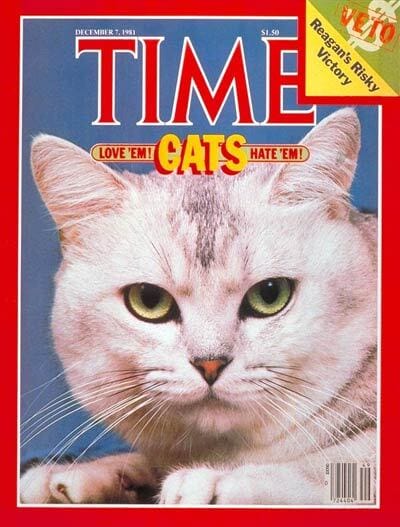 | The Dec. 7. 1981, cover of TIME |
| Neil Leifer |
| "The most famous feline to express this perplexing relationship between man and pet is Garfield, a comic-strip cat. His creator, Cartoonist Jim Davis, has three books on the New York Times trade paperback bestseller list, a first for any author…Garfield and his top-selling feline pals are but one example of the cat boom in the U.S., which now goes well beyond book and comic pages. There is, for example, Cats, an opulent, energetic rock musical adapted from T.S. Eliot's volume of poems Old Possum's Book of Practical Cats. The production has been a smash hit in London for nine months and will stalk onto Broadway early next year. Signature lines of kitty sheets, towels, ceramic cat planters, calendars, mugs, watches, umbrellas, T shirts, sweatshirts, stationery and housewares move swiftly at gift stores and specialty shops like Purrfection in New York and the Cat House in Los Angeles." |
|
| READ MORE » |
|
| | This week in 1994: Dogs |  | The Dec. 12, 1994, cover of TIME |
| Renee Lynn-Tony Stone Images |
| "[G]olden retrievers and other purebreds are not like most other animals. They are in a very real sense artificial, molded over thousands of years through selective breeding to satisfy human needs. For most of that time, those needs have largely been companionship and labor, and dogs have prospered. Within the past century, though, and especially over the past 50 years, the most popular types have been bred almost exclusively to look good—with 'good' defined by breed-specific dog clubs and the American Kennel Club (AKC)...The competition at dog shows is geared almost exclusively to looks. This focus on beauty above all means that attractive but unhealthy animals have been encouraged to reproduce—a sort of survival of the unfittest. The result is a national canine-health crisis, from which few breeds have escaped. The astonishing thing is that despite the scope of these diseases, veterinary researchers know next to nothing about what causes them or how to cure them." |
|
| READ MORE » |
|
| This week in 2005: Steven Spielberg | 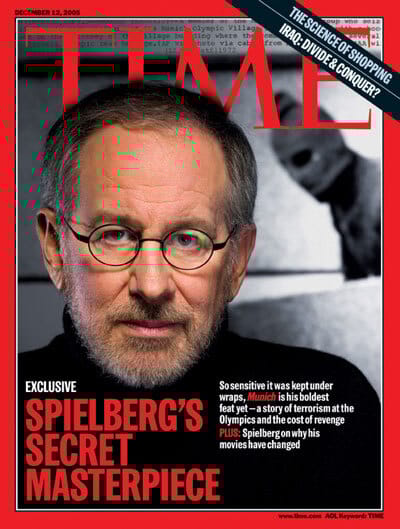 | The Dec. 12, 2005, cover of TIME |
| TIME |
| TIME: Do you think this film [Munich] will do any good?
Spielberg: I don't think any movie or any book or any work of art can solve the stalemate in the Middle East today. Everything's worth a try…What I'm doing is buying 250 video cameras and players and dividing them up, giving 125 of them to Palestinian children, 125 to Israeli kids, so they can make movies about their own lives—not dramas, just little documentaries about who they are and what they believe in, who their parents are, where they go to school, what they had to eat, what movies they watch, what CDs they listen to—and then exchange the videos. That's the kind of thing that can be effective, I think, in simply making people understand that there aren't that many differences that divide Israelis from Palestinians—not as human beings, anyway." |
|
| READ MORE » |
|
| | |
|


Comentarios
Publicar un comentario