|
|
|
|
BY PHILIP ELLIOTT
Senior Correspondent, TIME |
If Republicans can't get their arms around the spiraling costs of oil, they will need to get familiar with a new greeting: Hello, Speaker Hakeem Jeffries. |
The last 10 days have brought the single biggest disruption to oil in history. Markets have responded rationally with panic. A gallon of gas is up almost 50 cents from this point last week as the White House is giving confoundingly mixed messages about when this war might end or what would be considered a victory. |
Republicans' hopes of holding on to their slim majorities in the House and Senate may well hinge on the cost at the pump as the war against Iran lurches into its second week. |
And the math is pretty clear: there is a correlation between the cost of oil and losses endured by the party running the White House. The pattern can be seen going back half a century. |
In the last three midterms in which the price of oil was, adjusted for inflation, hovering around or above $100 a barrel at this point in the cycle, the party in the White House lost 29 House seats on average, according to a TIME analysis. |
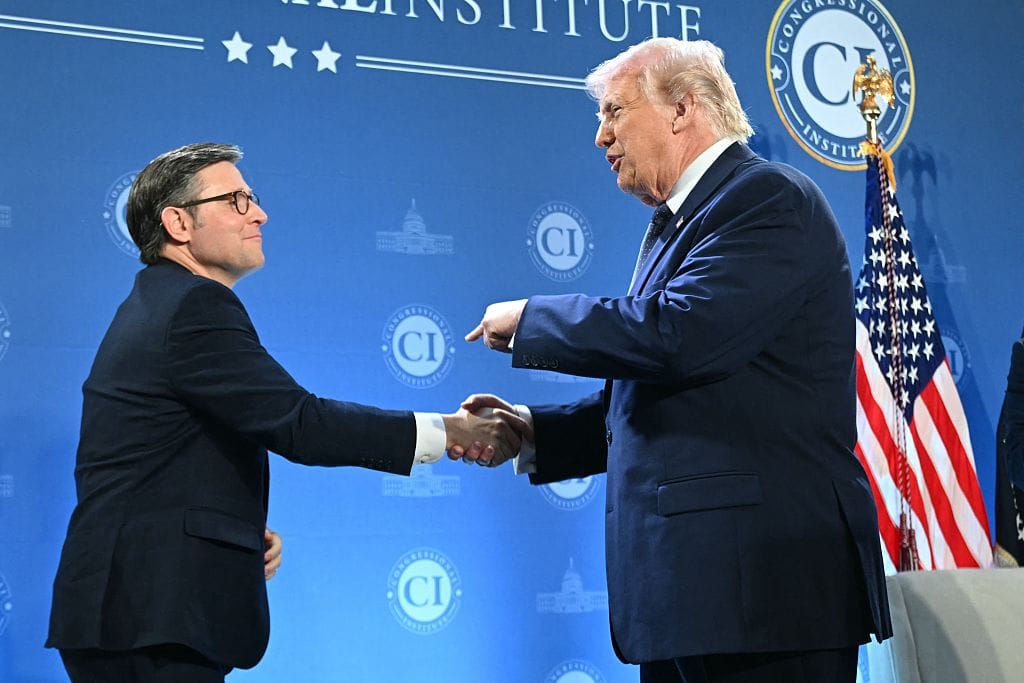
Speaker Mike Johnson can afford to lose just one vote to keep hold of his gavel. |
Trump's saving grace may be that it's only March. When oil prices slide lower as it gets closer to Election Day, as it did in 2014 and 2022, the wave elections can end up not being as big. But the numbers we are seeing now offer little comfort for GOP strategists hoping to ride out this Middle East turmoil, regardless of the cockiness coming from the White House. |
|
|
"They've gone up probably less than I thought they'd go up," Trump said Monday as he faced a brutal grilling about oil prices that could upend the economy and the last two years of his political power. |
The calendar year began with oil at $57 a barrel. Analysts warn it could cost triple that by the end of March if the Iran conflict continues to clog the Strait of Hormuz, a route that is responsible for about one-fifth of the world's crude oil production. |
Republicans see the peril as clear as day. In 2010, oil in today's dollars reached $113 in March of that midterm; Democratic President Barack Obama saw his party lose 64 seats. Four years later, things looked just as bad for Obama, with a barrel of crude that March hitting $132 in today's money. Oil prices fell closer to Election Day, as Obama lost another 13 seats. |
Trump's last midterm election in 2018 was more of a mixed bag. At this point in the cycle, oil was, in today's dollars, at just $79. But prices rose between March and September, when voters typically start paying attention to elections. Trump lost 42 allies in the House (but picked up seats in the Senate). |
Oil prices fell and U.S. stocks rose Monday afternoon on word that President Donald Trump said U.S.-Israeli war against Iran "is very complete, pretty much." But post-bell trading sank those gains. Oil hovered around $90 as trading began Tuesday just as Defense Secretary Pete Hegseth told reporters that this would be the most intense day of war with Iran yet—before saying it depends on Trump's whims if "it's the beginning, the middle, or the end." |
"He gets to control the throttle," Hegseth said. |
The muddled messaging left his allies flummoxed. "We have won in many ways, but not enough," Trump told GOP lawmakers on Monday. "We go forward more determined than ever to achieve ultimate victory that will end this long-running danger once and for all." |
And then when asked if the war would end this week, he hedged. "No." He said only "soon, very soon." |
Trump has rejected claims he has overthrown the government of Iran but then continues to walk himself right into that precise framing. "Look, everything they had is gone—including their leadership,'' Trump said. |
The ambiguity in messaging cannot mask the hard truths of commodity prices. Senate Majority Leader John Thune conceded on Monday that "the price of gas is always kind of a benchmark" and politicians need to watch voters' concerns about it. But there's not much that he can do about it as long as the Strait of Hormuz remains unpassable. |
To be fair, Presidents typically see disastrous report cards from voters in midterm elections. Since the Great Depression, only two midterms have shown positive trends for the party in the White House: the impeachment-weary 1998 electorate let President Bill Clinton's party pick up four House seats and the post-9/11 2002 midterms gave President George W. Bush a net eight seats. Otherwise, it's a slog in midterms that historically have been a resounding rejection of the party in power. |
|
But energy prices are often a big factor in just how deep the flesh can be cut. Cheaper energy can soften the blow for voters, but pricier fuel can fuel a wave election. It's not an exact line but the trend line is impossible to miss—both by political nerds and the public at large. Unlike GDP or CPI, voters are constantly noticing the price of gas, whether by when they fill up, or the impact high prices have on the costs of other goods. |
Trump won his second term in large measure to his messaging on the economy. He campaigned against Joe Biden—and then Kamala Harris—on the promise that he would make day-to-day life more affordable. His cornerstone promise was that he would cut energy costs by half. He was falling short on that vow even before the U.S. captured Venezuela's leader and unleashed a wave of attacks on Iran that left its Supreme Leader dead. |
Trump's allies in Congress see the latent threat. Biden's re-election campaign struggled for several reasons, but among the biggest was his inability to convince Americans that the pain they were feeling in their wallets was not real. The trickle-down effects of expensive energy—higher cost to ship goods, higher electric bills, less tourism heading into Spring Break and Summer Vacation seasons, tightened budgets on big-ticket appliances—stand to hit all corners of the economy. As much as Trump is trying to downplay these consequences, there really is no place for him to hide from them. |
"It's going to be ended soon," Trump said. "And if it starts up again they'll be hit even harder." |
Election Day is a little less than eight months away. |
READ THE STORY » |
|
|
|
|
|
|
|






Comentarios
Publicar un comentario