| | | | BY PHILIP ELLIOTT
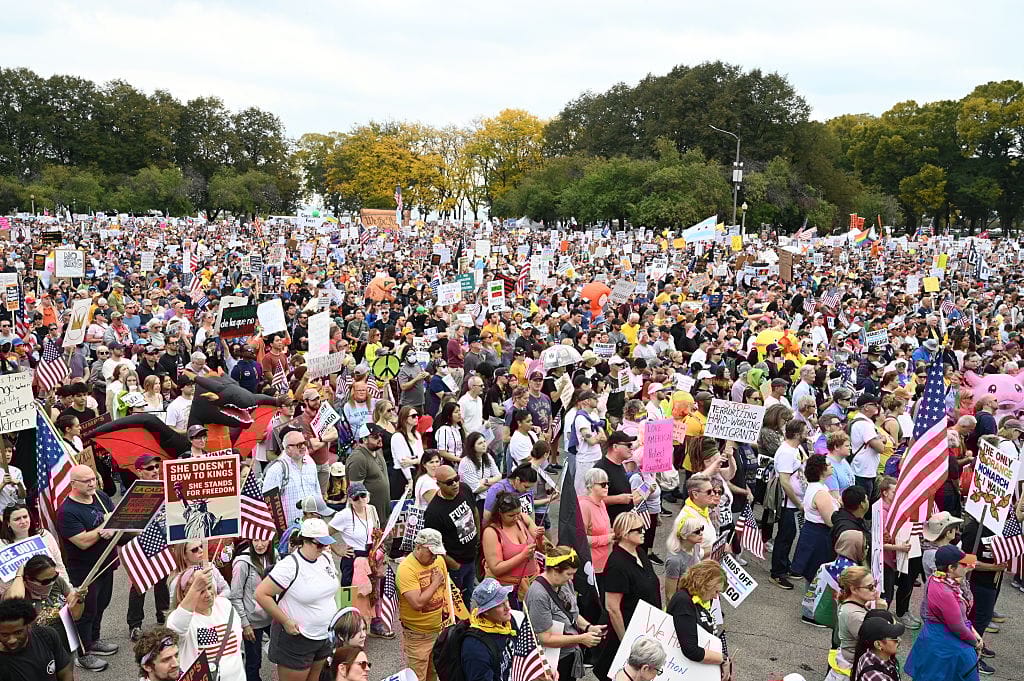
Senior Correspondent, TIME | The next widespread protest against President Donald Trump is set to draw big numbers. As missiles continue flying across the Middle East, gas prices keep rising, and airport security lines continue stretching ever longer, there is no reason to think Saturday's third nationwide No Kings protest will be anything smaller than the one in October that drew millions. In fact, all signs point to March 28 potentially being the single largest day of domestic political protest in history. | After all, Trump has the highest disapproval rating of any President at this point in his presidency in this century. | But for those looking for meaning in the venting, the makeup of those coming out to protest should draw just as much attention as their size. As they've grown bigger, these millions-strong protests are shifting from partisan echo chambers venting rage into something somewhat closer to the broader electorate. If the trend continues this Saturday, Republicans should be terrified. | Since Trump's first term, an American University sociologist and her fellow researchers affiliated with the nonpartisan Brookings Institution have been conducting surveys of protesters, starting with the Women's March of 2017. They continued that work in Trump's second term, surveying those in attendance at the People's March last January, the first No Kings March in June, and second No Kings protest in October. | | The most striking shift they found has been in the gender of the protesters. In January of 2025, 77% of the People's March were women, according to the Brookings project. In October's No Kings 2.0 events, that number sank to 57%. | The shift away from white protesters was nowhere near as pronounced. Nonetheless, on Saturday, the overall makeup of the protesters is likely to be less female, and potentially less white and less lefty, compared to early last year, and maybe even compared to just last October. | To be fair, we're still looking at a slice of the electorate that has been largely anti-Trump from early on. Still, it's important to note the trends away from the stereotypical, privileged protester. (The groups are still better-educated than their neighbors; while a little more than one-third of Americans over age 25 have at least a bachelor's degree, even the least-schooled of the protest groups were weighted college grads by a 3-to-1 margin.) | But notably, those showing up to protest are also moving to a more mellow vibe—and it's quantifiable. Let's start with a question Brookings asked to the crowds at the start of Trump's second term: whether things have gotten so off track in the United States that violence might be the only answer. In January of last year, 33% of protesters said violence might be the solution. By the first No Kings protest in June, it was up to 40%. But by October, weeks after the assassination of conservative leader Charlie Kirk, that number was back down to 23%, and the share rejecting political violence outright hit 59%. | | That shift might be the most telling detail of these surveys, that these protests are falling more into the mainstream. In national surveys, support for political violence is still at a worrying 21% in researchers' national surveys. Among self-described folks on the Left, that number stood at 26% in November—an increase of nine points nationally from a year earlier. But for the folks at October's No Kings 2.0 rally, that hovered at 23%—down 10 points from where the year began. | So, yes, the crowds stand to hit a new record for political demonstration in this country and that's worth heeding. Anything that boosts civic and civil engagement in this democracy is a positive sign. But let's also look at who is in these crowds and what they might preview the mood of all Americans heading into this election season, after one that involved multiple moments of deadly violence. | No Kings organizers are predicting their largest turnout yet, with protests in all 50 states, and in cities around the world. The flagship protest in Minneapolis, where Bruce Springsteen is set to perform, may be among the biggest. But Saturday may be a hint about so much more than sign-making talents. The marches may tell us just who is frustrated with Trump and how much appetite they have for a peaceful change in their government. | READ THE STORY » | | | | | | | | | |
|





Comentarios
Publicar un comentario