| |
| |
Hello there. Many Americans struggled with rising health care costs this year, and 2027 is likely to be even worse. Our story below examines the perfect storm of soaring premiums, more people going uninsured, and rising costs for everyone else. |
We’re also bringing you an exclusive interview with Itamar Ben-Gvir, a far-right Israeli politician who is hoping to play kingmaker in Israel’s Oct. 27 election. |
|
|
IN TODAY’S BRIEF |
|
|
|
|
|
| |
|
|
|
| |
| |
READ THIS FIRST |
Exclusive: Ben-Gvir’s plan to push Netanyahu right |
 |
Ilia Yefimovich—AFP/Getty Images |
|
The ultra-nationalist Itamar Ben-Gvir is a far-right firebrand once deemed too extreme to serve in Israel’s military. He now sits in Benjamin Netanyahu’s cabinet as national security minister, overseeing the country’s police and prison services. |
If Ben-Gvir has his way, the Oct. 27 election in Israel will give his party more seats in parliament and himself greater leverage over another right-wing government led by Netanyahu. His ambition is not to replace the prime minister but to make him even more dependent on the hardline parties pushing for Palestinians to leave Gaza and the West Bank—and for Israel to extend sovereignty over the territories. |
“I want Netanyahu to be prime minister. He’s a leader. I prefer him a million times over Eisenkot,” Ben-Gvir tells TIME in a rare interview on Oct. 19, referring to Netanyahu’s chief rival, the former military chief Gadi Eisenkot. Pounding his chest, he adds: “What will really help Netanyahu be right wing is if I, Ben-Gvir, will be a senior minister and it’s a full right-wing government.”—Eric Cortellessa |
Read the full interview here. |
|
|
|
| |
|
|
|
|
|
|
|
| |
| |
HAPPENING NOW |
Venezuelans take to the streets to demand democracy |
 |
Jesus Vargas—Getty Images |
|
Thousands of protesters took to the streets in Venezuela on Thursday afternoon to demand presidential elections and call for the return of exiled Nobel Prize-winning opposition leader María Corina Machado. |
In the capital, Caracas, protesters gathered in Plaza Venezuela and called for presidential elections to be scheduled as early as 2027, as well as the release of all political prisoners in the country. |
Protesting has become common for disgruntled Venezuelans since the forced end of Nicolás Maduro’s presidency. Maduro and his predecessor Hugo Chávez heavily cracked down on political dissent. But since Maduro’s removal in January by U.S. forces, protesters have taken to the streets “with increasing frequency,” according to the international civil society alliance CIVICUS, citing data from the Venezuelan Observatory of Social Conflict, which recorded 1,101 protests during just the month of September, or about 37 demonstrations per day. These protests, however, have not necessarily been large. |
Until this week. The Thursday protests, which Reuters described as “the first nationwide opposition protest in nearly two years,” coincided with the third anniversary of the opposition’s presidential primary elections, in which Machado emerged victorious. |
Since arresting Maduro in an extraordinary military operation in January, the U.S. has been working with an interim government led by Delcy Rodríguez, Maduro’s former deputy. Rodríguez and U.S. President Donald Trump both have said elections will eventually be held in the country, though Trump told TIME in late September: “It’s so raw now, you know that I just think it’s too soon.” —Chad de Guzman |
Read the full story here. |
|
|
|
| |
|
|
|
| |
| |
IN THE NEWS |
U.S. reportedly considering major strikes on Iran after midterms |
 |
Shadati—Xinhua/Getty Images |
|
The U.S. and Israel are reportedly developing plans for major strikes on Iran after the U.S. midterm elections in November. |
Citing people familiar with the deliberations, the New York Times reported on Wednesday that Defense Secretary Pete Hegseth discussed the possibility of renewed strikes on Iran with Israeli Prime Minister Benjamin Netanyahu in Israel this week. Possible targets of the strikes reportedly include Iran’s energy infrastructure, nuclear facilities, and missile and drone arsenal. |
U.S. officials have repeatedly asserted that the Iranian Islamic Revolutionary Guard Corps are teetering on the edge of collapse but are deliberately prolonging the war in an effort to meddle with Republican prospects in the midterm elections. |
Here’s the catch: |
Some officials have reportedly argued that resuming attacks for an intense but limited campaign would hasten Iran’s economic collapse and make it more amenable to negotiations. But that hasn’t worked so far. Tehran’s reluctance to make concessions to the U.S. appears to have strengthened, rather than weakened, over the course of the war. Iranian leaders reiterated this week that they will not directly negotiate with the U.S. unless Washington accedes to certain demands, which include ending its naval blockade and releasing frozen Iranian funds. —Miranda Jeyaretnam
|
|
|
|
| |
|
|
|
| |
| |
SPONSORED BY ROKU |
How Jennifer Aniston’s LolaVie brand grew sales 40% with CTV ads |
|
|
The DTC beauty category is crowded. To break through, Jennifer Aniston’s brand LolaVie, worked with Roku Ads Manager to easily set up, test, and optimize CTV ad creatives. The campaign helped drive a big lift in sales and customer growth, helping LolaVie break through in the crowded beauty category. |
Learn more |
|
|
|
| |
|
|
|
| |
| |
IN FOCUS |
Health care costs are becoming unsustainable |
 |
Douglas Sacha—Getty Images |
|
Amber Kostka, who owns The Stockpot restaurant in Hampton Roads, Va., says she has tried to do right by her employees by offering them health insurance, alongside good wages and a 401k. |
But as costs have risen—premiums have roughly tripled since the company first started offering health insurance in 2018—her employees are increasingly telling her they can’t afford health insurance. That’s even though she splits the cost of premiums with employees, which are roughly $400 a month. |
Instead, employees are dropping out of the plan and going uninsured, she says. About 35% of her eligible employees now buy the employer-sponsored health insurance, she says, down from 50% prior to COVID. She wants to warn them about the risks of going without insurance, she says, but also knows their finances are extremely tight. “It’s just a cost thing, at the end of the day,” she says. “You can’t stop paying for groceries.” |
Her employees aren’t alone. The share of working-age U.S. adults without health insurance rose to 11.2% in 2026, up from 8.9% in 2024, according to new research from the Commonwealth Fund. People don’t have health insurance because the costs of everything—including gasoline, housing, and food—are rising, and they’re deciding they can’t afford to pay for even employer-sponsored plans like Kostka’s. “The whole system just seems like a complete gamble with people’s lives,” she says. |
Some people are looking at the price of plans on the Affordable Care Act marketplace and deciding they can’t afford health insurance. Premiums on the ACA marketplaces increased by an average of 58% in 2026 after Congress decided last year not to renew expiring subsidies. |
Ironically, these uninsured Americans may be helping drive the cost of health care even higher, fueling a cycle in which health insurance gets more expensive, forcing more people to drop coverage. As hospitals field more uninsured patients, they have to pass the costs of uncompensated care onto someone. “When providers have to provide a lot of uncompensated care, how do they make themselves whole? They raise prices,” says Beth Umland, director of employer research for Marsh, the health benefits consultant company formerly known as Mercer. |
Of course, having more uninsured Americans isn’t the only reason costs are rising. A Marsh survey of employers recently found that they expected total health benefit costs per employee to rise 8.2% in 2027, the highest increase since 2003. One reason was that the consolidation of health systems was leading to higher prices, as some systems had monopolies in certain markets. Another was that lower government spending for public health programs was leading to higher costs for private sector plans. —Alana Semuels |
Read the full story here. |
|
|
|
| |
|
|
|
| |
| |
ONE NUMBER |
2,700 |
France's Justice Minister Gérald Darmanin said on Thursday that 2,700 people have been taken into police custody since Saturday in connection with riots and looting. Protests began in September over the state of French schools and have grown into wider discontent about the economy in the last week. |
SOURCE: REUTERS |
|
|
|
| |
|
|
|
| |
| |
A VIRAL MOMENT |
Destroyer of worlds |
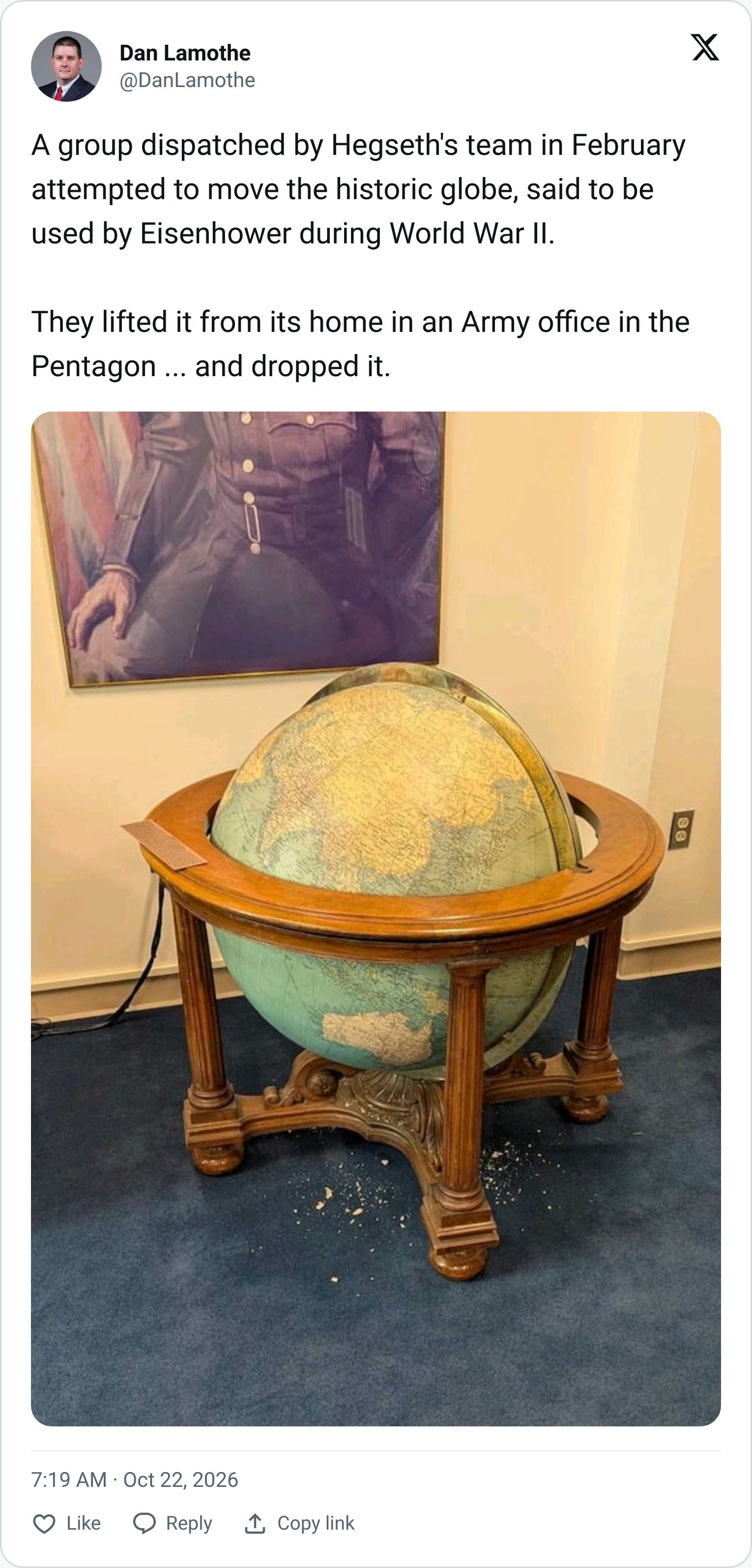
In February this year, Defense Secretary Pete Hegseth wanted a floor globe used by Gen. Dwight D. Eisenhower during World War II, and that was housed in the Pentagon. These kinds of historical artifacts are moved by trained curators, but the Washington Post reports that Hegseth dispatched his own team to relocate the globe, and members of that team dropped it during the move. |
|
|
|
|
|
| |
|
|
|
| |
| |
SPONSORED BY WISPR FLOW |
Turn today's calls into tomorrow's proposal |
|
|
Wispr Flow Notetaker brings your meetings into Claude or ChatGPT through a built-in connector. Ask for a proposal draft or a deal recap, and your AI works from an accurate record of what was said. |
Get Wispr Flow Notetaker |
|
|
|
| |
|
|
|
|
| |
 |
| Linked |
| In this addictive word-association game, find the steps that will unite two seemingly unrelated words in just four moves. |
 |
| PLAY NOW |
|
|
| |
|
|
|
|
|
|
|
| |

Click to sign up.
|
|
|
|
|
|




Comentarios
Publicar un comentario