| |
| |
|
Hello there. Donald Trump spent Thanksgiving taking aim at Vladimir Putin and at his own government. The U.S. President urged the Russian leader to pull back military aggression across Europe, while on social media he accused his own Commerce Department—without evidence—of deliberately understating an economic growth statistic before the midterms.
|
|
We also take a look at whether Democrats’ sweeping midterm victories could cool the redistricting wars, and why the sense of connection people get around the holidays shouldn’t disappear once the leftovers do.
|
|
|
IN TODAY’S BRIEF
|
-
Trump demands probe into ‘fake’ numbers
-
Putin warned
-
Connection beyond the holidays
-
Redistricting after the midterms
-
Lights out
-
The Meyers kids take over Late Night
|
|
|
|
| |
|
|
|
| |
| |
NITPICKING NUMBERS
|
Trump accuses his own government of falsifying economic data
|
 |
|
Daniel Heuer—Getty Images
|
|
|
President Donald Trump has accused his own government of deliberately falsifying economic data before the midterm elections in which Republicans saw sweeping losses.
|
|
“I would like to wish a Happy Thanksgiving to even those who issued fake Economic Numbers, just prior to the Election, and corrected them yesterday, three weeks late,” Trump posted on Truth Social Thursday. “A RECORD SETTING ERROR, and one so grave that it should be immediately investigated.”
|
|
On Wednesday, the Commerce Department’s Bureau of Economic Analysis (BEA) revised its estimate of third-quarter annualized growth to 4.3%, up from the advance estimate of 3.4% published on Oct. 29. Annualized growth tracks how much the economy would grow over a year if it kept growing at that quarter’s pace. The updated figures, which were published according to a prescheduled calendar, reflect an increase from 2.2% in the second quarter.
|
|
In another post on Thursday, Trump called the revision a “massive, and purposeful, error.” He did not provide evidence of manipulation. The BEA routinely revises its estimates of annualized growth and other economic data. —Miranda Jeyaretnam and Chad de Guzman
|
|
Read the full story here.
|
|
|
|
| |
|
|
|
| |
| |
SPONSORED BY TLDR AI
|
The AI news without the noise
|
|
|
|
TLDR AI covers the model releases, research, and tools that actually matter, curated by engineers from OpenAI, Adobe, and ex-Google DeepMind. It’s a 5-minute read, delivered every weekday morning.
|
|
Subscribe for free
|
|
|
|
| |
|
|
|
| |
| |
PUBLIC PLEA
|
Trump urges Putin to ‘pull back’ military aggression in Europe
|
 |
|
Andrew Harnik—Getty Images
|
|
|
President Donald Trump on Thursday said he would like to see Russian President Vladimir Putin “pull back all military aggression against territories throughout Europe” in the hope that a deal can be made to end the Russia-Ukraine war.
|
|
Expressing his belief that a deal can be made “quickly,” Trump said: “I really believe this is a strong possibility. Thousands of people are being killed each and every month. A complete bloodbath.”
|
|
The U.S. President didn’t specify what he meant by “territories throughout Europe,” but his remarks come amid concerns over the possible expansion of the Russia-Ukraine war. A number of recent incidents involving NATO members have also sparked fears.
|
|
Last week, Poland accused Russia of violating its airspace after two missiles and a drone crashed in its territory. Russia denied violating Poland’s airspace. Estonia also recently accused Russian security services of ordering an attempted arson attack on an Estonian defense company. Russia’s Ministry of Foreign Affairs called the accusation “unfounded,” denying Moscow’s involvement.
|
|
Tensions escalated further this week when Russia alleged that Estonia was quietly allowing Ukrainian drones to use its airspace to strike northwestern Russia and accused Tallinn of trying to obstruct Russian cargo ships in the Baltic Sea. Estonia vehemently denied both accusations, calling them “baseless,” with Foreign Minister Margus Tsahkna stressing that the country “has not allowed and will not allow its territory or airspace to be used for drone attacks against Russia from Ukraine.” —Tiago Ventura and Olivia-Anne Cleary
|
|
Read the full story here.
|
|
|
|
| |
|
|
|
| |
| |
SPONSORED BY WISPR FLOW
|
Wispr Flow Notetaker is now on iPhone
|
|
|
|
Record in-person conversations and get a clean summary and transcript afterward. Notetaker keeps recording even with your phone locked.
|
|
Get it on iPhone
|
|
|
|
|
|
|
|
| |
|
|
|
| |
| |
LASTING CONNECTION
|
Connection must be more than a holiday tradition
|
 |
|
skynesher—Getty Images
|
|
|
At Thanksgiving, people share stories, discuss milestones, maybe even acknowledge personal challenges. And before it’s time for pumpkin pie, we’ve learned something new about one another and feel more connected than before.
|
|
Unfortunately, experiences like this happen too infrequently.
|
|
Today, loneliness and social isolation are among the most pressing public health challenges facing our country. According to a new Social Connection in America survey, 40% of Americans report moderate to severe loneliness. Nearly 70% get together with others no more than once or twice a month. While connecting virtually is a routine part of daily life for many, only 24% of people say it is as satisfying as spending time together in person.
|
|
The consequences are real and extend beyond feeling down or lonely. According to the Centers for Disease Control and Prevention, a lack of social connection is associated with an increased risk of heart disease, stroke, Type 2 diabetes, dementia, earlier death, and other serious health conditions.
|
|
The good news is that spaces for connection are all around us. The challenge for each of us is to step into those spaces, open ourselves up to new relationships, and prioritize our intrinsic need for human connection. —Suzanne McCormick
|
|
Read the full essay here.
|
|
|
|
| |
|
|
|
| |
| |
RETHINKING REDISTRICTING
|
What Democrats’ sweeping midterm wins could mean for the redistricting battle
|
 |
|
Emily Elconin—Bloomberg/Getty Images
|
|
|
Republicans and Democrats in several states engaged in a bitter fight to redraw congressional maps in their parties’ favor leading up to this year’s midterms. But in the aftermath of the blue wave that swept across the country, that conflict may be dying down—at least for now.
|
|
Typically, maps are redrawn after the results of the U.S. census are released each decade, in order to account for population and demographic changes. Last year, however, President Donald Trump urged members of his party to redistrict mid-cycle ahead of the 2026 election as the GOP vied to hold onto its narrow House majority. Several Republican-led states moved to do so in the ensuing months, while Democratic leaders in other states responded with their own redistricting efforts, with varying degrees of success.
|
|
Costas Panagopoulos, a professor of political science at Northeastern University, says that Republicans may be more reluctant to push for redistricting mid-cycle going forward, given that their efforts failed to counteract the blue wave in this year’s election.
|
|
In states like Texas, North Carolina, Ohio, Alabama, and Florida, Democratic candidates came out on top in multiple districts that had been redrawn to benefit Republicans—which political experts have largely attributed to the fact that, despite redistricting efforts, Republicans were still facing a challenging political climate at a time when Trump’s approval rating was at a historic low.
|
|
“In recent years, Democrats have been reluctant to engage in mid-cycle redistricting. Republicans have been more willing to do that, and Democrats have followed suit in response in order to counteract some of the districts created by Republicans to advantage themselves,” Panagopoulos says.
|
|
“But as 2026 showed us, those efforts often amount to very little and can even backfire, so I think both parties right now are cautious about any mid-cycle redistricting efforts, and 2026 suggests that even if districts are very heavily gerrymandered to advantage one party or the other, there are no guarantees that those parties will win.”
|
|
That doesn’t mean that partisan gerrymandering has come to an end. The next redistricting cycle will take place after the 2030 census, and Panagopoulos says, “When it’s a redistricting cycle, both parties engage to the extent that they can in partisan gerrymandering.” Democrats, he says, “will remain better positioned to engage in pro-Democratic redistricting in part because of the gains that they made in state legislatures and governorships across the country.” —Chantelle Lee
|
|
Read the full story here.
|
|
|
|
| |
|
|
|
| |
| |
ONE NUMBER
|
|
961,000
|
|
Nearly a million U.S. utility customers were without power at 7:30 p.m. ET on Thanksgiving as severe storms battered the East Coast.
|
SOURCE: POWEROUTAGE.US
|
|
|
|
| |
|
|
|
| |
| |
A VIRAL MOMENT
|
Who let the turkeys out?
|
|
Seth Meyers’ children and niece took over his annual Thanksgiving show with a seasonal rendition of “Who Let the Dogs Out”—and a predictably chaotic and adorable attempt at hosting NBC’s late-night show.
|
|
|
|
|
|
| |
|
|
|
| |
| |
SPONSORED BY SUPERHUMAN AI
|
1,000+ Claude Prompts Top Professionals Actually Use at Work
|
|
|
|
Claude can be your analyst, editor, and strategist.
|
|
But most professionals are using it to fix grammar.
|
|
These 1,000+ Claude prompts take it from grammar tool to your most powerful AI work assistant.
|
|
Sign up for Superhuman AI and get:
|
-
1,000+ ready-to-use Claude prompts to get real work done in minutes — researched, tested, and used by professionals at Google, Microsoft, and NASA
-
Superhuman AI newsletter (4 min daily) so you keep learning new AI tools and skills to stay ahead in your career — the prompts are just the beginning
|
|
Claim your free prompts
|
|
|
|
| |
|
|
|
| |
 |
| Linked |
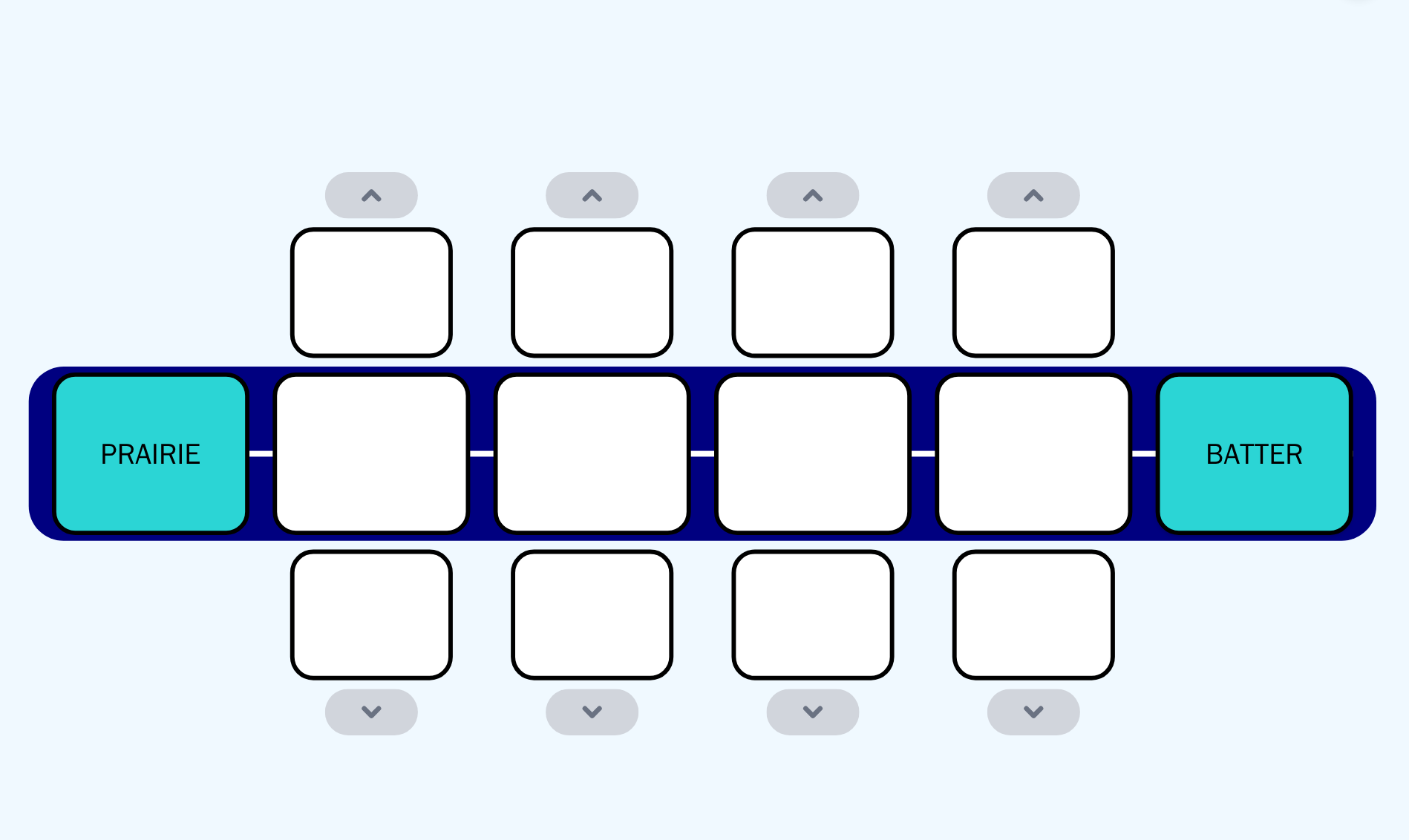
| In this addictive word-association game, find the steps that will unite two seemingly unrelated words in just four moves. |
 |
| PLAY NOW |
|
|
| |
|
|
|
|
|
|
|
| |

Click to sign up.
|
|
|
|
|
|





Comentarios
Publicar un comentario