| |
| |
Hey there. Today’s The Brief pays tribute to Dolores Huerta, the renowned activist who died yesterday at age 96. I remember, when I met and spoke with Huerta in Los Angeles in 2023 as TIME honored her as one of our inaugural Latino Leaders, being amazed at how passionate and committed to fighting for worker and human rights she remained even into her old age. |
But first, we look at what Trump’s historically low approval rating might mean for the midterms. We also examine how today’s space race has become much more complicated than the space race of decades ago. |
|
|
IN TODAY’S BRIEF |
Trump’s unpopularity at the polls Spain’s train crash Remembering Dolores Huerta The peptide rush A new, more complex space race The cost of war LIFE returns
|
|
|
|
| |
|
|
|
| |
| |
READ THIS FIRST |
The President’s approval is at a new low. What history says that might mean for the midterms |
 |
Kent Nishimura—AFP/Getty Images |
|
With the pivotal November elections looming, President Donald Trump’s approval rating earlier this month dropped to the lowest point of his second term—and the lowest level of any President heading into the midterms in decades. |
Trump’s approval rating fell to 30% in early October, according to the Pew Research Center. The last American President with a comparably low approval rating this close to the midterms was Harry Truman in 1946. |
Typically, the party in the White House loses congressional seats in the midterms. There are, however, exceptions to this trend. In 2002, then-President George W. Bush’s Republican Party actually gained seats in both the House and the Senate in the midterm elections. Political experts like Costas Panagopoulos, a professor of political science at Northeastern University, largely attribute the GOP’s success in the 2002 midterms to Bush’s high approval rating—63% heading into the midterms, according to Gallup data—in the aftermath of the Sept. 11, 2001, terrorist attacks. |
“I think we can expect Republicans to be facing an uphill battle at the polls,” Panagopoulos says about the 2026 elections. “The question is: Will they lose enough seats to lose the majority in either or both those chambers? That is entirely within the realm of possibility. And that has to do both with Trump’s relatively low approval rating, historically speaking, but also the constellation of candidates in the mix.” —Chantelle Lee |
Read the full story here. |
|
|
|
| |
|
|
|
| |
| |
SPONSORED BY THE MARKETING MILLENNIALS |
A free newsletter with the marketing ideas you need |
|
|
The best marketing ideas come from marketers who live it. That’s what The Marketing Millennials delivers: real insights, fresh takes, and no fluff. Written by Daniel Murray, a marketer who knows what works, this newsletter cuts through the noise so you can stop guessing and start winning. Subscribe and level up your marketing game. |
Sign Up Free |
|
|
|
| |
|
|
|
| |
| |
HAPPENING NOW |
Spain probes cause behind deadly high-speed train crash |
 |
Alejandro Martinez Velez—Europa Press/Getty Images |
|
Spanish authorities are investigating what was behind a high-speed train collision that killed at least 68 people and injured dozens of others. The country’s transport minister suggested that a combination of “inexplicable” human error and computer failure was likely behind the tragedy. |
A state-operated train with 393 people on board slammed into the rear of a stationary privately-operated train near Urda, Toledo, more than 80 mi. south of Madrid on Wednesday morning. Transport Minister Óscar Puente pointed to a central command center's authorization to resume traffic, and he said the person who made the call has been identified, though their name has not yet been publicized. |
The context: |
The Oct. 28 collision comes after a high-speed train crash in January in the Spanish city of Adamuz, where 46 people died and 122 sustained injuries. Despite the latest accident, Puente insisted that the Spanish rail system is “safe and comparable to that of other countries” in the region. —Chad de Guzman
|
Read the full story here. |
|
|
|
| |
|
|
|
| |
| |
IN PROFILE |
The trailblazing life of activist Dolores Huerta |
 |
Marvin Joseph—The Washington Post/Getty Images |
|
Dolores Huerta, an internationally renowned activist, community organizer, and political force who co-founded what is now known as the United Farm Workers of America alongside Cesar Chavez, died Wednesday at her home in Bakersfield, California. She was 96. |
News of Huerta’s death was shared by family members through her Instagram account, though the post did not disclose a cause of death. The New York Times reported that the cause of death was cancer, citing a spokesperson for Huerta. |
Huerta dedicated her career to fighting a variety of causes, including labor rights, women’s rights, and immigrants’ rights. She is also credited with coining the phrase “Sí, se puede,” or “yes, we can,” which was later adopted by Barack Obama. |
In March, Huerta publicly accused Chavez of sexually abusing her decades earlier. Huerta said she had remained silent for decades because she feared damaging the movement to which she had devoted her life. Coming forward after a Times investigation into allegations that Chavez abused other women and girls, she emphasized that the movement’s achievements belonged to thousands of people. —Jasmine Aguilera |
Read the full story here. |
|
|
|
| |
|
|
|
| |
| |
HEALTH CHECK |
The peptide rush has begun |
 |
Getty Images |
|
The U.S. Department of Health and Human Services will not take action against licensed pharmacists who dispense certain unapproved peptides to consumers, according to a new policy published Oct. 28 in the Federal Register. |
Peptides are short chains of amino acids that people inject into their bodies. HHS Secretary Robert F. Kennedy Jr. has said in the past that he is a “big fan” of the unapproved drugs, whose benefits are largely scientifically unproven. |
The U.S. Food and Drug Administration essentially banned peptides in 2023 because of safety concerns. But an FDA committee met in July to review the evidence on peptides and recommend whether or not to take the highly unusual step of allowing pharmacies to dispense them absent scientific review. The committee was made up of new appointees who consulted with or were employed by companies that were interested in promoting or dispensing peptides; it recommended allowing specialty pharmacies to dispense six peptides, despite FDA staff advising against the move. |
A document posted on the HHS website says that after reviewing the recommendations of the committee that met in July, “the Secretary has determined that the policy advances patient choice and freedom while appropriately protecting patient safety.” |
The decision to allow the compounding of peptides is a boon for companies like Hims & Hers, which had reportedly been preparing to offer peptides in 2026. Compounding pharmacies are often used to fill specific prescriptions from a doctor, but in recent years, they have mass-produced drugs like GLP-1s for patients looking to save money. Analysts have said the market for peptides could be as high as $3.3 billion. Hims stock shot up 5% after the Oct. 28 announcement. |
Other public-health professionals raised alarm about the decision, which they say allows compounding pharmacies to dispense these medications absent scientific evidence. —Alana Semuels |
Read the full story here. |
|
|
|
| |
|
|
|
| |
| |
SPONSORED BY CRYPTOLARK |
Solana's price collapsed. Its network didn't. Dormant wallets are waking up, inflation is falling, and Firedancer is rolling out. Stop guessing the bottom. Get our full thesis, metrics, and risks. |
Get Free Guide |
|
|
|
| |
|
|
|
| |
| |
IN FOCUS |
Why NASA’s Artemis III mission will be one of its most complex flights ever |
 |
Kent Nishimura—AFP/Getty Images |
|
The last time the folks at NASA tested a crewed lunar lander in low-Earth orbit, a Saturn 5 rocket lifted off from the Kennedy Space Center in Florida carrying three astronauts, an Apollo spacecraft, and a lunar module. Then they got to orbit and the astronauts flew both ships. Then they came home. That straightforward mission was accomplished 57 years ago, during the flight of Apollo 9. |
The next time NASA attempts something of the kind—during the planned flight of Artemis III in the summer of 2027—things will be a lot more complicated. |
First, an uncrewed Blue Origin New Glenn rocket will launch from KSC carrying the company’s Blue Moon lander into orbit. Then, NASA will launch its prosaically named Space Launch System moon rocket, carrying the four Artemis III astronauts aboard an Orion spacecraft. Then the crew will rendezvous with the Blue Moon, dock with it and enter it, checking out its systems before returning to the Orion. Then SpaceX will launch a Starship rocket carrying its own Starship lander, which will also be uncrewed. The astronauts will rendezvous and dock with that ship, too, but not enter it since it will not yet be equipped with a life support system. Then they will separate and the crew will spend a few more days running tests on the Orion. All of that work will take up to 17 days from first liftoff to splashdown. And only if everything goes just right with that mission can NASA achieve its goal of landing astronauts on the lunar surface during the 2028 flight of Artemis IV—and in the process, win a new space race with China. |
On Oct. 23, NASA Administrator Jared Isaacman and other officials conducted a marathon two-hour press conference at KSC, detailing plans for Artemis III and IV, conceding that the hurdles are considerable, but insisting the goals are within reach. The current NASA, with its tight funding and long timelines, may not be the old NASA that used its generous budgets and garage full of rockets to pop off nine crewed Apollo lunar missions just from 1968 to 1972, but it will be no less successful, they said. |
But for all the confidence expressed at the conference, no one at NASA pretends that the Artemis III mission doesn’t have a lot of moving parts and that a lot of things could go badly wrong before the space agency can tee up the 2028 Artemis IV landing. |
Isaacman acknowledges that NASA’s years of uncertainty since the Apollo program—with priorities shifting from Skylab to the shuttle to the International Space Station, and with start-stop programs to return to the moon that burned through money but never got anywhere—have set the agency back, especially as it concerns the ongoing competition with China. |
“Here we are today, very much in a new space race,” he says, “and despite decades of accumulated knowledge and extraordinary advancements in technology, this race will be much closer than it ever needed to be.” —Jeffrey Kluger |
Read the full story here. |
|
|
|
| |
|
|
|
| |
| |
ONE NUMBER |
$47.1 billion |
The cost of the Iran war to American taxpayers has grown to $47.1 billion, according to an updated estimate the Pentagon provided to Congress, the Associated Press reports. |
SOURCE: ASSOCIATED PRESS |
|
|
|
| |
|
|
|
| |
| |
A VIRAL MOMENT |
LIFE returns |
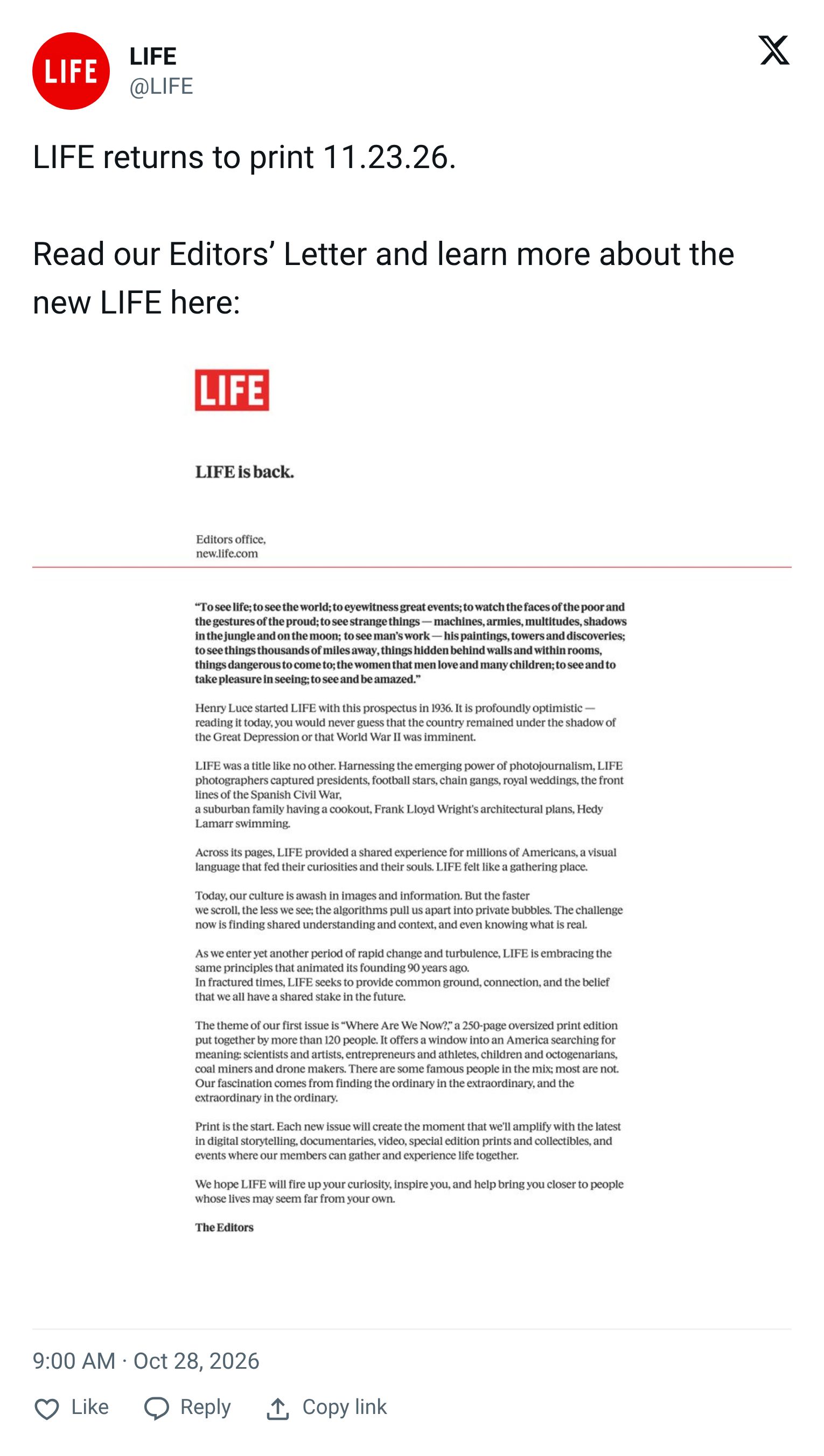
The famed photojournalism magazine LIFE, which was founded 90 years ago by TIME’s co-founder Henry Luce but stopped publishing regularly in the 2000s, is relaunching next month under new management, according to an editors’ note announcing the return. |
|
|
|
|
|
| |
|
|
|
| |
| |
SPONSORED BY WISPR FLOW |
Stop typing AI prompts. Start talking. |
|
|
You think 4x faster than you type. So why are you typing prompts? Wispr Flow turns your voice into ready-to-paste text inside any AI tool. Speak naturally, tangents and all, and Flow cleans it up. Available on Mac, Windows, iPhone, and Android. |
Try Wispr Flow Free |
|
|
|
| |
|
|
|
|
| |
 |
| Linked |
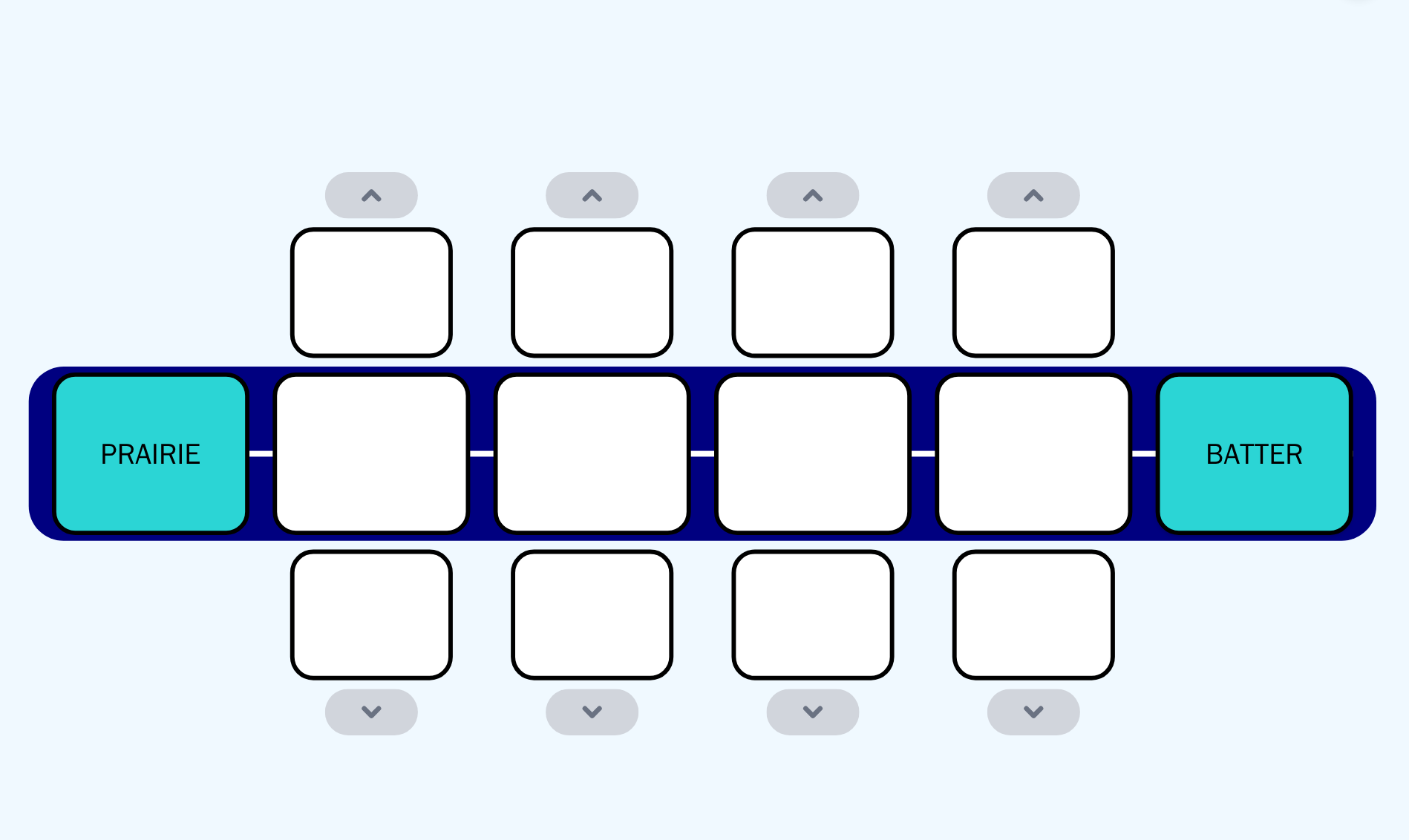
| In this addictive word-association game, find the steps that will unite two seemingly unrelated words in just four moves. |
 |
| PLAY NOW |
|
|
| |
|
|
|
|
|
|
|
| |

Click to sign up.
|
|
|
|
|
|




Comentarios
Publicar un comentario